This time, Inamori* spoke about the above motto in Kyocera philosophy.
What Inamori said is quoted with “”.
“In other words, in a social and economic climate where it is already difficult for a single person just to survive, carrying the responsibility of employing—and providing livelihoods for—ten, twenty, or even fifty employees is no small matter.
Even supporting oneself, or one’s own family, is a heavy burden. To employ others and continue to protect their livelihoods is an extraordinary responsibility.
‘I will have you succeed me as president,’ you might say, ‘but in doing so, I am entrusting you with the grave responsibility of how you will protect the one hundred employees we currently have.’
In that statement lies a kind of moral justification, or higher purpose:
‘To protect employees, to protect their jobs—that is your destiny. You may suffer hardships beyond what your natural talents would suggest, but that is precisely your fate.’”
(Quoted from the Inamori Digital Library)
On this occasion, a business owner learning at the Seiwajuku asked Mr. Inamori,
“I am considering passing on the business I founded to my son. What mindset should he have, and what points should he be careful about?”
In response, Mr. Inamori spoke as quoted above.
Furthermore, when we examine Mr. Inamori’s destiny chart through the lens of Sanmei-gaku (Chinese destiny science), we find a major characteristic known as Nacching. This indicates a life path that differs from one’s parents, or one that brings about reforms not previously seen in society.
Viewed from this perspective of reform, Mr. Inamori’s life as a business leader can truly be described as a continuous series of reforms.

In this article, taking into account the reforms Mr. Inamori actually carried out, I would like to consider three key points that successors who inherit a business from their parents should keep in mind:
1. Re-define the purpose and significance of the business
2. Cultivate approachability and human warmth
3. Acquire true strictness (taizen, great goodness)
I will now explain each point in greater depth.
1. Re-define the purpose and significance of the business
Inamori’s Words
“That is why you must tell your son this without fail:
‘In the end, the only way you can lead employees is through your character.
You are still young, your abilities are not yet proven, and you cannot lead people by age or talent alone.
There is no other way but to lead through character.
And that character is defined by your humility and your sincerity.’”
(Quoted from the Inamori Digital Library)
→ My Comment
Mr. Inamori has said that he had Kyocera created in order to present his technology to the world and put it to the judgment of society.
However, shortly after the company’s founding, he was confronted by employees demanding serious discussions. Through that experience, he came to realize that company management exists for one purpose alone:
to pursue the material and mental fulfillment of all employees.
Clarifying the purpose and significance of a business in this way—this, I believe, was one of the greatest and most important reforms Mr. Inamori carried out.
Until then, even if companies spoke beautifully in principle, the reality was often that a company existed to maximize the financial profits of shareholders and a small group of executives.
Mr. Inamori, however, clearly defined the purpose and meaning of corporate existence and consistently upheld the position of a leader who works for the sake of employees.
I cannot help but feel that this must have been an extraordinarily difficult path to take.
2. Cultivate approachability and human warmth
Inamori’s Words
“If a successor simply takes over as a matter of course and goes about it casually, the long-serving employees are bound to feel dissatisfied.
It doesn’t matter if it’s yakitori or anything else—set up a gathering and go around saying,
‘I have no experience yet, I am still young, and I may not even have sufficient ability, but I sincerely ask for your support.’
Bow deeply and ask each person in earnest.
At the very least, that humility, that sincere and serious attitude, is what makes people think,
‘If he is willing to say that much, then I suppose we should cooperate with him.’
That is what I believe is required.”
(Quoted from the Inamori Digital Library)
→ My Comment
This may have been mentioned in the Seiwajuku internal publication, but Mr. Inamori himself once said that he was not originally good at parties or banquets. He was not naturally sociable, and at such gatherings he would often find himself standing idly by the wall, holding a single beer.
However, once he became the leader of a company and assumed the role of guiding employees, he could no longer afford to remain that way.
He recognized that social gatherings were an invaluable opportunity—places where people could open their hearts, speak honestly, and where energy could be shared and transmitted among all participants. To make full use of these occasions, he realized that he himself had to take the initiative and speak.
In this way, I believe Mr. Inamori reformed himself and went on to practice a style of management centered on these gatherings.

3. Acquire true strictness (taizen, great goodness)
Inamori’s Words
“At times, I was extremely kind and considerate toward my subordinates, deeply concerned for their well-being.
And yet, there were moments when I had to ‘cut off the trusted staff with tears in my eyes’—to dismiss an employee because of an issue that had arisen.
I often struggled inwardly, wondering which version of myself was the real one.
Was it the kind, compassionate leader who cared for subordinates, thinking that a person should not be dismissed over such a failure?
Or was it the seemingly heartless leader who believed that, although the matter itself might appear small, leaving it unresolved would ultimately destroy the entire organization—and therefore decided to let that person go?
I found myself wrestling with this question time and again.”
(Quoted from the Inamori Digital Library)
→ My Comment
Mr. Inamori himself has spoken of his own nature as being timid or even easily frightened, using such expressions about himself.
And yet, when he believed that something would not truly benefit the other person, or that leaving an issue unaddressed would eventually ruin the entire organization, he did not hesitate. He has recounted moments when he reprimanded staff so severely, on the spot, that they could barely remain standing.
To reveal such a severe side—so severe that others might think one’s personality had completely changed—this too is a form of reform.
I believe that such reform, even the reform of one’s own character, is sometimes indispensable in management.

To summarize, when inheriting a company from one’s parents, what must be reformed is not only the company itself, but also the successor.
That reform consists of clearly defining the purpose and significance of the business, cultivating warmth, humanity, and approachability, while at the same time possessing a strictness that stands in complete contrast to those qualities.
It is this kind of self-reform, I believe, that is ultimately required.
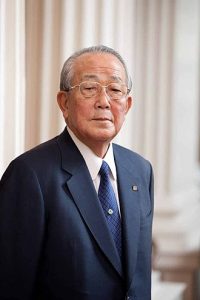
* Mr. Kazuo Inamori, the founder of Kyocera, KDDI (one of the top tele communication companies in Japan) and the top of revitalization project of JAL. As a well-known Japanese entrepreneur, he has been sharing his experiences and management know-how with managements of small to middle companies in Japan.
Further queries or doubts, please email to ytomizuka@abrilsjp.com
News Letter subscription is here